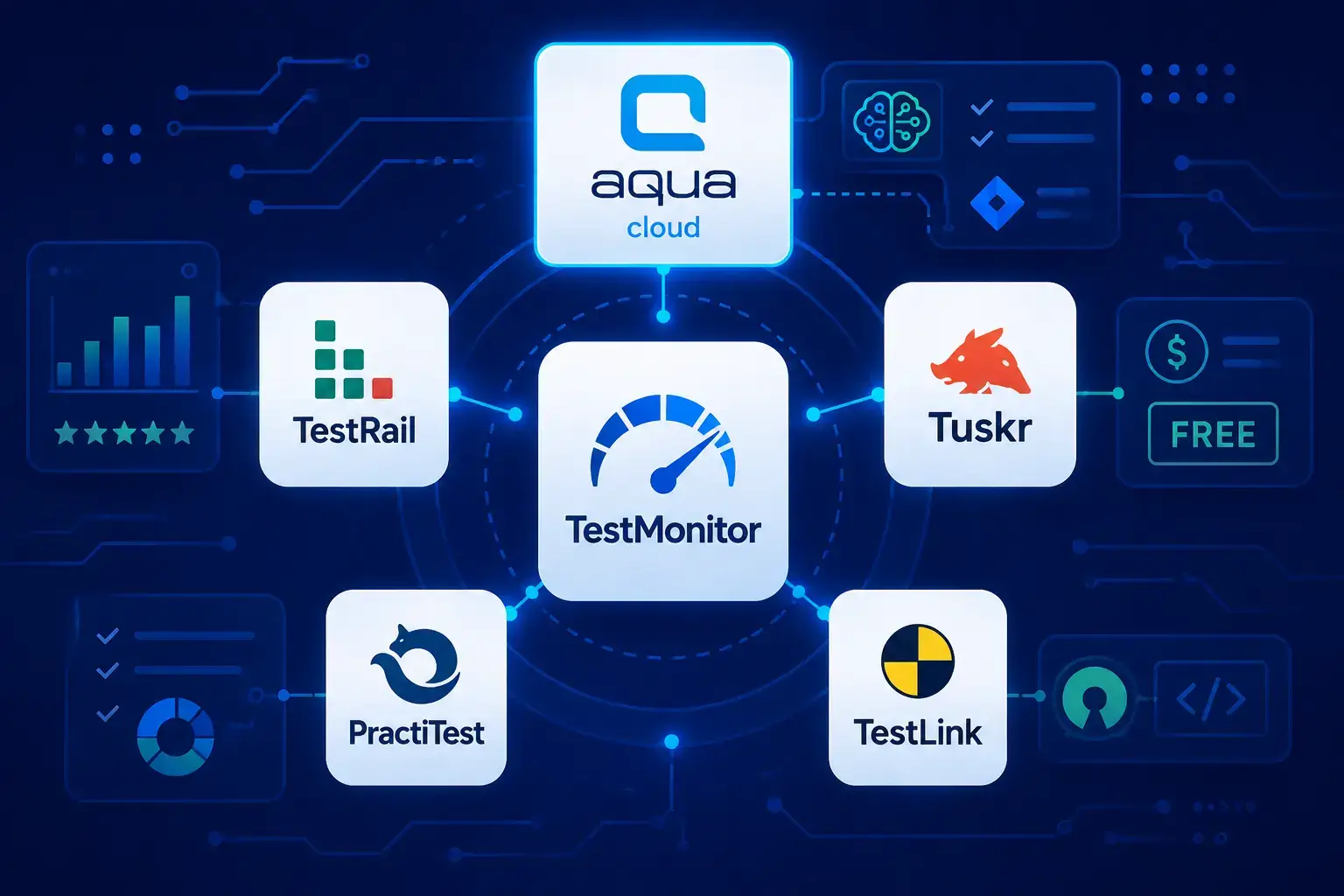
Key Takeaways
- aqua cloud is the strongest overall pick if you want AI-generated test cases, centralised test management with manual and automated tests, and native integrations including Jira, Confluence, and Azure DevOps without TestMonitor’s manual setup work.
- TestMonitor’s own users report a real learning curve around terminology and initial test plan setup, though overall satisfaction is high.
- TestRail is G2’s top-ranked alternative to TestMonitor, based on user comparison data.
- Tuskr is the cheapest genuine alternative, undercutting TestMonitor’s entry price with a real free tier.
- PractiTest is the closest match for teams that need TestMonitor’s traceability and dashboards but want more customization.
- TestLink is the only free, open-source option in this comparison.
Compare TestMonitor alternatives at a glance
| Tool |
Best for |
Starting price |
Free tier |
Integrations |
AI test generation |
| aqua cloud |
Teams that want AI test generation plus broad native integrations |
Contact for pricing |
No, free trial available |
12 native integrations (Jira, Confluence, Jenkins, Ranorex, Azure DevOps, JMeter, SoapUI, and more) plus REST API |
Yes, via aqua Intelligence |
| TestRail |
Teams wanting formal structure with strong automation integrations |
$37/user/month |
No, free trial available |
Jira, GitHub, Azure DevOps, and CI/CD tools via integration |
No |
| Qase |
Small to mid-sized teams wanting a modern interface |
Free for up to 3 users |
Yes |
Jira, GitHub, GitLab, CI/CD tools |
Limited |
| Tuskr |
Budget-conscious teams that still want structure |
$9/user/month |
Yes |
Basic bug tracker integrations |
No |
| PractiTest |
Mid-to-large teams needing customizable dashboards |
$49/user/month |
No, free trial available |
Jira, GitHub, CI/CD tools, custom API |
Limited |
| TestLink |
Teams that want a free, self-hosted option |
Free, open source |
Yes |
Limited, mostly manual or self-built |
No |
TestMonitor itself starts at $11 per user monthly (Starter, 3 users included), $16 per user monthly (Professional, scalable across 5, 10, 25, 50, or 100-user tiers), and custom Enterprise pricing starting at 10 users.
Move to a 100% AI-powered TMS and centralise your testing efforts in a few minutes
What do TestMonitor users actually say?
TestMonitor holds a 4.4 out of 5 rating on G2 from 12 reviews, and Capterra reviews follow a similar pattern: users consistently praise the intuitive interface and quick regression suite setup. This isn’t a tool people are fleeing from.
The one real, recurring friction point shows up in a Capterra review, where a user described the initial setup honestly: it “took time to learn and adjust to what the terms are in the software, suite, case, requirements, etc.” to build out test plans for larger, longer-term projects. The same reviewer noted the issue was resolved with a single onboarding session with TestMonitor’s team, which also tracks with TestMonitor’s reputation for responsive support.
So the honest reason to look at alternatives isn’t that TestMonitor is bad. It’s that the structure and terminology take a real ramp-up period, and the per-seat pricing scales with team size in a way that matters if you’re a smaller team or don’t need the full risk-based feature set.
Which is the best overall TestMonitor alternative?
aqua cloud reads your requirements documents, including images, PDFs, and UML diagrams, and generates test cases using equivalence partitioning and boundary value analysis. Around 42% of the cases it generates need zero edits, which removes a real chunk of the manual setup work that makes TestMonitor’s onboarding feel heavy. You can keep refining drafts through chat until they match what you need, and aqua flags duplicate test cases automatically so your suite doesn’t bloat over time.
QA teams have called out how well the AI feature performs against expectations:
- One G2 reviewer said aqua Intelligence “exceeded my expectations” for generating test cases from requirements, adding that it lets QA professionals “allocate more time towards other critical testing tasks.”
- Another reviewer highlighted how fast teams can get started: “one can start in minutes” setting up a project and writing test cases, calling the AI feature a way to save “lots of time” for testers and test managers alike.
Beyond Jira, aqua cloud connects natively to Jenkins and Azure DevOps for CI/CD, Confluence for pulling live documentation straight into test cases, and Ranorex for automated testing across web, mobile, and desktop. Twelve integrations ship out of the box in total, plus a fully documented REST API for anything not covered natively, a meaningfully wider connectivity story than TestMonitor’s more limited native integration set.
aqua cloud also ships with Capture, which auto-logs console output and network data and sends bug reports straight to aqua or Jira, so you’re not switching tools to file a clean bug report. And unlike TestMonitor’s tiered per-seat pricing that climbs with every team size jump, aqua cloud’s pricing is built around what your team actually uses.
Remove half of your testing efforts with the power of AI
What's the cheapest TestMonitor alternative?
Tuskr, without much competition. TestMonitor’s Starter plan runs $11 per user monthly for up to 3 users. Tuskr starts at $9 per user monthly and has a genuine free tier, which G2’s comparison data confirms is one of its strongest advantages against TestMonitor, alongside a setup process reviewers describe as notably straightforward.
Qase is worth checking too, since its free tier covers the same 3-user ceiling as TestMonitor’s Starter plan at no cost at all.
Is there a direct TestMonitor replacement with more customization?
aqua cloud. It offers the same core strengths TestMonitor is known for, live dashboards, custom workflows, and traceability between requirements, tests, and defects, with more flexibility in how you configure it.
PractiTest is worth looking at too. It’s not cheaper (starting around $49 per user monthly), and the initial setup is comparably involved, so this is a lateral move for teams that want TestMonitor’s structure with more room to customize it, not a way to cut cost or complexity.
Is there a free, open-source alternative to TestMonitor?
TestLink. It’s fully open source and free to self-host, which removes licensing cost entirely, but it comes with a real tradeoff: more setup and maintenance work than any hosted tool in this comparison, including TestMonitor.
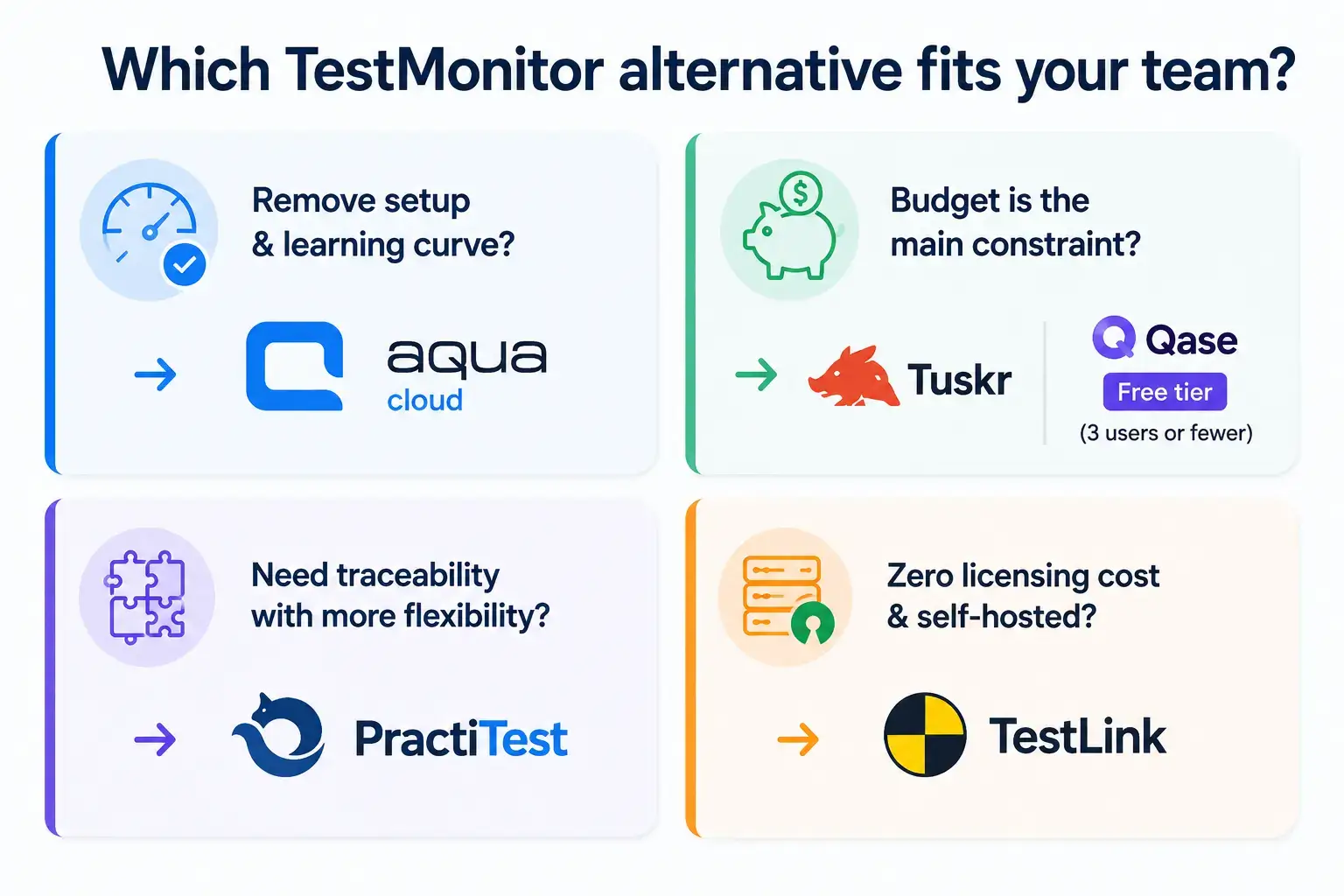
Which TestMonitor alternative fits your team?
- You want to remove the setup and terminology learning curve TestMonitor’s own users report: aqua cloud.
- Budget is the main constraint: Tuskr, or Qase’s free tier if your team is 3 people or fewer.
- You need TestMonitor’s traceability with more configuration flexibility: PractiTest.
- You want zero licensing cost and can handle self-hosting: TestLink.
- You’re also comparing against TestRail or Katalon directly: see our TestRail alternatives and Katalon alternatives comparisons for the automation and CI/CD side of this decision.
This image was generated with AI.