We use cookies and third-party services that store or retrieve information on the end device of our visitors. This data is processed and used to optimize our website and continuously improve it. We require your consent fro the storage, retrieval, and processing of this data. You can revoke your consent at any time by clicking on a link in the bottom section of our website. Privacy Policy.
Customise Consent Preferences
We use cookies to help you navigate efficiently and perform certain functions. You will find detailed information about all cookies under each consent category below.
The cookies that are categorised as "Necessary" are stored on your browser as they are essential for enabling the basic functionalities of the site. ...
Always Active
Necessary cookies are required to enable the basic features of this site, such as providing secure log-in or adjusting your consent preferences. These cookies do not store any personally identifiable data.
Cookie
gf_email_otp_seed_3
Duration
2 hours
Description
Used to temporarily store the OTP verification seed required for secure form or email verification.
Cookie
gf_email_otp_seed_12
Duration
2 hours
Description
Used to temporarily store the OTP verification seed required for secure form or email verification.
Cookie
gf_email_otp_seed_6
Duration
2 hours
Description
Used to temporarily store the OTP verification seed required for secure form or email verification.
Cookie
gf_email_otp_seed_1
Duration
2 hours
Description
Used to temporarily store the OTP verification seed required for secure form or email verification.
Cookie
gf_email_otp_seed_4
Duration
2 hours
Description
Used to temporarily store the OTP verification seed required for secure form or email verification.
Cookie
gf_email_otp_seed_10
Duration
2 hours
Description
Used to temporarily store the OTP verification seed required for secure form or email verification.
Cookie
gf_email_otp_seed_5
Duration
2 hours
Description
Used to temporarily store the OTP verification seed required for secure form or email verification.
Cookie
VISITOR_PRIVACY_METADATA
Duration
6 months
Description
YouTube sets this cookie to store the user's cookie consent state for the current domain.
Cookie
GAESA
Duration
1 month
Description
Description is currently not available.
Cookie
aquaSessionId2
Duration
2 days
Description
Description is currently not available.
Cookie
aquaXAuthId2
Duration
2 days
Description
Description is currently not available.
Cookie
rc::a
Duration
Never Expires
Description
This cookie is set by the Google recaptcha service to identify bots to protect the website against malicious spam attacks.
Cookie
rc::c
Duration
session
Description
This cookie is set by the Google recaptcha service to identify bots to protect the website against malicious spam attacks.
Cookie
__Secure-ENID
Duration
1 year 1 month
Description
The __Secure-ENID cookie is a type of secure cookie used for authentication and to ensure the security of user sessions.
Cookie
LS_CSRF_TOKEN
Duration
session
Description
Cloudflare sets this cookie to track users’ activities across multiple websites. It expires once the browser is closed.
Cookie
zalb_*
Duration
session
Description
Zoho sets this cookie for load balancing and session stickiness. It ensures that user requests are consistently directed to the same server during a session, helping maintain session integrity and improving website performance.
Cookie
GCLB
Duration
session
Description
This cookie is known as Google Cloud Load Balancer set by the provider Google. This cookie is used for external HTTPS load balancing of the cloud infrastructure with Google.
Cookie
cookieyes-*
Duration
1 year
Description
CookieYes sets this cookie for consent solution management.
Cookie
__cf_bm
Duration
1 hour
Description
This cookie, set by Cloudflare, is used to support Cloudflare Bot Management.
Functional cookies help perform certain functionalities like sharing the content of the website on social media platforms, collecting feedback, and other third-party features.
Cookie
VISITOR_INFO1_LIVE
Duration
6 months
Description
A cookie set by YouTube to measure bandwidth that determines whether the user gets the new or old player interface.
Cookie
ytidb::LAST_RESULT_ENTRY_KEY
Duration
Never Expires
Description
The cookie ytidb::LAST_RESULT_ENTRY_KEY is used by YouTube to store the last search result entry that was clicked by the user. This information is used to improve the user experience by providing more relevant search results in the future.
Cookie
__session
Duration
1 year 1 month 4 days
Description
GitBook sets this cookie for logging in.
Cookie
uesign
Duration
1 month
Description
Zoho sets this cookie for the Visitor Live Chat.
Cookie
_tldtest_*
Duration
session
Description
Amplitude sets this cookie to determine the highest-level domain where cookies can be set. Deleted after testing.
Cookie
lidc
Duration
1 day
Description
LinkedIn sets the lidc cookie to facilitate data center selection.
Cookie
li_gc
Duration
6 months
Description
Linkedin set this cookie for storing visitor's consent regarding using cookies for non-essential purposes.
Analytical cookies are used to understand how visitors interact with the website. These cookies help provide information on metrics such as the number of visitors, bounce rate, traffic source, etc.
Cookie
gf_visitor_source
Duration
7 days
Description
Stores visitor attribution data such as source, medium, campaign, content, term, and location for analytics and lead attribution.
Cookie
gf_visitor_medium
Duration
7 days
Description
Stores visitor attribution data such as source, medium, campaign, content, term, and location for analytics and lead attribution.
Cookie
gf_visitor_campaign
Duration
7 days
Description
Stores visitor attribution data such as source, medium, campaign, content, term, and location for analytics and lead attribution.
Cookie
gf_visitor_content
Duration
7 days
Description
Stores visitor attribution data such as source, medium, campaign, content, term, and location for analytics and lead attribution.
Cookie
gf_visitor_term
Duration
7 days
Description
Stores visitor attribution data such as source, medium, campaign, content, term, and location for analytics and lead attribution.
Cookie
gf_visitor_location
Duration
7 days
Description
Stores visitor attribution data such as source, medium, campaign, content, term, and location for analytics and lead attribution.
Cookie
ga_session_duration
Duration
1 hour
Description
Stores visitor attribution data such as source, medium, campaign, content, term, and location for analytics and lead attribution.
Cookie
_ga_*
Duration
1 year 1 month 4 days
Description
Google Analytics sets this cookie to store and count page views.
Cookie
_ga
Duration
1 year 1 month 4 days
Description
Google Analytics sets this cookie to calculate visitor, session and campaign data and track site usage for the site's analytics report. The cookie stores information anonymously and assigns a randomly generated number to recognise unique visitors.
Cookie
amp_*
Duration
1 year
Description
Amplitude sets this cookie for session tracking for analytics purposes.
Cookie
YSC
Duration
session
Description
YSC cookie is set by Youtube and is used to track the views of embedded videos on Youtube pages.
Cookie
amplitude_device_id
Duration
session
Description
No description available.
Cookie
loom_anon_comment
Duration
1 year
Description
No description available.
Cookie
loom_referral_video
Duration
session
Description
Description is currently not available.
Cookie
__Host-psifi.analyticsTrace
Duration
6 hours
Description
Description is currently not available.
Cookie
__Host-psifi.analyticsTraceV2
Duration
6 hours
Description
Description is currently not available.
Cookie
_cs_id
Duration
1 year 1 month
Description
This cookie is used to store the ContentSquare's user identifier ID. This is a persistent cookie and expires after 13 months.
Cookie
_cs_s
Duration
1 hour
Description
This cookie is used to store the number of page's viewed by a visitor within the session for ContentSquare's solution.
Cookie
ai_session
Duration
1 hour
Description
This is a unique anonymous session identifier cookie set by Microsoft Application Insights software to gather statistical usage and telemetry data for apps built on the Azure cloud platform.
Cookie
_hjSessionUser_*
Duration
1 year
Description
Hotjar sets this cookie to ensure data from subsequent visits to the same site is attributed to the same user ID, which persists in the Hotjar User ID, which is unique to that site.
Cookie
_hjSession_*
Duration
1 hour
Description
Hotjar sets this cookie to ensure data from subsequent visits to the same site is attributed to the same user ID, which persists in the Hotjar User ID, which is unique to that site.
Cookie
ajs_anonymous_id
Duration
1 year
Description
This cookie is set by Segment to count the number of people who visit a certain site by tracking if they have visited before.
Cookie
_cs_c
Duration
1 year 1 month
Description
This cookie is used by Contentsquare to store the user's consent preference for analytics and session replay tracking.
Cookie
utm_medium
Duration
7 days
Description
This cookie is used to record from where the visitor came to the website orginally. This information is used by the website operator to know the efficiency of their marketing.
Cookie
utm_source
Duration
7 days
Description
This cookie is used to record from where the visitor came to the website orginally. This information is used by the website operator to know the efficiency of their marketing.
Cookie
utm_campaign
Duration
7 days
Description
Google Ad Services sets this cookie to store session campaign value if present.
Cookie
utm_content
Duration
7 days
Description
This cookie is used for storing the session content value if present.
Cookie
utm_term
Duration
7 days
Description
This cookie is used to record from where the visitor came to the website orginally. This information is used by the website operator to know the efficiency of their marketing.
Cookie
amp_cookie_test*
Duration
session
Description
Amplitude sets this cookie to test if cookies are enabled in the user’s browser. It is used during SDK initialisation and is automatically removed after the check.
Cookie
utsdb
Duration
session
Description
Zoho SalesIQ sets this cookie to register data on visitor's website behaviour.
Performance cookies are used to understand and analyse the key performance indexes of the website which helps in delivering a better user experience for the visitors.
Cookie
_uetsid
Duration
1 day
Description
Bing Ads sets this cookie to engage with a user that has previously visited the website.
Cookie
_uetvid
Duration
1 year 24 days
Description
Bing Ads sets this cookie to engage with a user that has previously visited the website.
Advertisement cookies are used to provide visitors with customised advertisements based on the pages you visited previously and to analyse the effectiveness of the ad campaigns.
Cookie
_gcl_au
Duration
3 months
Description
Google Tag Manager sets this cookie to experiment advertisement efficiency of websites using their services.
Cookie
__Secure-ROLLOUT_TOKEN
Duration
6 months
Description
YouTube sets this cookie to manage feature rollout and experimentation. It helps Google control which new features or interface changes are shown to users as part of testing and staged rollouts, ensuring consistent experience for a given user during an experiment.
Cookie
__Secure-YEC
Duration
past
Description
Description is currently not available.
Cookie
__Secure-YNID
Duration
6 months
Description
YouTube cookie used to protect user security and prevent fraud, especially during the login process.
Cookie
test_cookie
Duration
15 minutes
Description
doubleclick.net sets this cookie to determine if the user's browser supports cookies.
Cookie
MUID
Duration
1 year 24 days
Description
Bing sets this cookie to recognise unique web browsers visiting Microsoft sites. This cookie is used for advertising, site analytics, and other operations.
Cookie
ai_user
Duration
1 year
Description
Microsoft Azure sets this cookie as a unique user identifier cookie, enabling counting of the number of users accessing the application over time.
Cookie
NID
Duration
6 months
Description
Google sets the cookie for advertising purposes; to limit the number of times the user sees an ad, to unwanted mute ads, and to measure the effectiveness of ads.
Cookie
__Host-GAPS
Duration
2 years
Description
This cookie allows the website to identify a user and provide enhanced functionality and personalisation.
Cookie
bcookie
Duration
1 year
Description
LinkedIn sets this cookie from LinkedIn share buttons and ad tags to recognize browser IDs.
Cookie
IDE
Duration
1 year 24 days 1 minute
Description
Google DoubleClick IDE cookies store information about how the user uses the website to present them with relevant ads according to the user profile.
Cookie
guest_id_marketing
Duration
1 year 1 month 4 days
Description
Twitter sets this cookie to identify and track the website visitor.
Cookie
guest_id_ads
Duration
1 year 1 month 4 days
Description
Twitter sets this cookie to identify and track the website visitor.
Cookie
personalization_id
Duration
1 year 1 month 4 days
Description
Twitter sets this cookie to integrate and share features for social media and also store information about how the user uses the website, for tracking and targeting.
Cookie
guest_id
Duration
1 year 1 month 4 days
Description
Twitter sets this cookie to identify and track the website visitor. It registers if a user is signed in to the Twitter platform and collects information about ad preferences.
Other uncategorised cookies are those that are being analysed and have not been classified into a category as yet.
Cookie
_cs_root-domain
Duration
session
Description
Description is currently not available.
Cookie
aquacloudio-_zldp
Duration
1 year 1 month 4 days
Description
Description is currently not available.
Cookie
aquacloudio-_zldt
Duration
1 year 1 month 4 days
Description
Description is currently not available.
Cookie
amplitude_testaqua-cloud.io
Duration
1 year
Description
Description is currently not available.
X
🤖 Exciting new updates to aqua Intelligence are now available! 🎉
Mastering Test Case Dependencies: A Guide for Effective Testing
In software testing, there's a critical piece that often goes unnoticed but can make or break your testing strategy. We're talking about test case dependencies, and they're more important than you might think. Have you ever felt like you're navigating through chaos when testing software? Test case dependencies can be like a secret map to help you understand it all. They are the key to saving time and resources while avoiding confusion and bottlenecks. In this article, we'll shed light on these hidden connections and show you how to master them, giving your testing team the tools they need to succeed.
Test dependencies are the connections between test cases that determine execution order, data conditions, and environment requirements across your test suite.
Dependent test cases in testing fall into six categories: prerequisite, temporal, data, functional, resource, and environment dependencies. Each requires a different management approach.
Unmanaged test dependencies create bottlenecks, circular dependencies, and cascading failures that slow down your entire release cycle.
Automation handles execution order, parallel runs, and data setup, but your team still needs clear dependency documentation before automation can be effective.
The right test management tool eliminates manual dependency tracking by visualising relationships and flagging conflicts before test execution begins.
Here is how to identify, document, and manage test case dependencies so your team stops losing time to avoidable failures. 👇
What are the test case dependencies?
Test case dependencies in testing are the complex connections and relationships among test cases within a software testing plan. They signify that executing one test case can either affect or rely on the results or conditions established by another test case. Essentially, these dependencies represent the links and interdependencies between your test cases that affect the order in which you do the tests and the results you get.
If you can understand and manage test case dependencies, you can improve your test planning and execution significantly. It enables you to establish a well-defined sequence for executing test cases, ensuring that prerequisite tests are completed before dependent tests. Also, this sequence will help you identify potential bottlenecks and optimise testing processes. It ultimately leads to more efficient and thorough testing, which is critical in your journey to achieving software quality and reliability.
Types of test case dependencies
Dependent test cases in testing fall into distinct categories, and knowing which type you are dealing with determines how you document, sequence, and automate them. Several distinct categories define the relationships between test cases. After learning how many types there are, you will question yourself, not just ‘Should we have dependent test cases?‘ but rather ‘How deep should we go?’ and ‘How exactly do we want to build it? Here’s a breakdown of the common types:
Prerequisite dependencies occur when one test case must be executed before another can begin. Completing the prerequisite test case is essential for your dependent test case to proceed.
Temporal dependencies are based on timing and scheduling. They dictate the specific order in which you should execute the test cases to simulate real-world scenarios accurately.
Data dependencies arise when test cases rely on specific data inputs or conditions to produce meaningful results. You should ensure the availability and accuracy of the required data for these dependencies.
Functional dependencies occur when the output of one test case serves as the input for another. This chaining of test cases is common in scenarios where you test the application’s functionality in stages.
Resource dependencies appear when some test cases require access to specific hardware, software, or network resources to execute successfully.
Environment dependencies involve the testing environment itself. Test cases may rely on the presence of certain configurations, settings, or infrastructure components to function correctly.
Understanding these various test case dependencies is essential for effective test planning and execution. It helps you prioritise test cases, minimise bottlenecks, and ensure testing efforts align with the desired testing objectives. Speaking about bottlenecks, there are plenty of them in test case dependencies that require your full attention and commitment. But do not worry; we have you covered in the next paragraph.
Challenges in managing test case dependencies
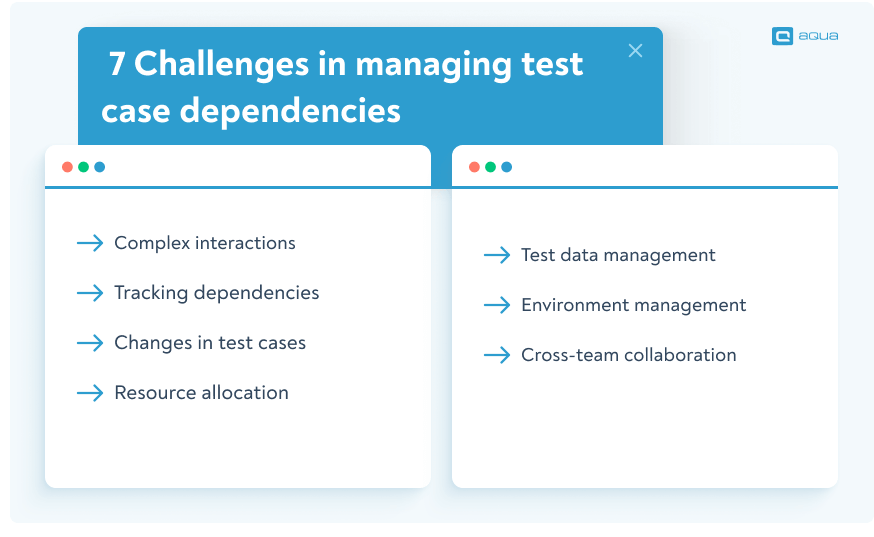
Test dependencies create specific failure patterns that repeat across projects and teams. Knowing what to expect means you can put preventive measures in place before they slow your team down. Challenges abound, and it’s essential to recognise and address them effectively. Here are some common challenges that you may encounter:
Complex interactions: Test case dependencies can become complex when multiple test cases rely on each other in complicated ways. Managing and ensuring these interactions don’t lead to deadlocks or circular dependencies can be challenging. To overcome this, you should use clear and well-defined dependencies, consider asynchronous communication, and employ techniques like dependency injection.
Tracking dependencies: Keeping track of dependencies manually can be error-prone, especially in large-scale projects with numerous test cases. It’s easy to miss or mismanage dependencies when they’re not documented systematically. To tackle this, you can automate dependency tracking using test management tools and version control systems to ensure accurate documentation and reduce errors in large-scale projects with numerous test cases.
Changes in test cases: As test cases evolve or are updated, their dependencies may also change. Ensuring these changes are properly reflected and managed can be a constant challenge. You have to regularly update and automate the tracking of test case dependencies using version control systems and test management tools, ensuring that changes in test cases are promptly reflected and managed to meet evolving project requirements.
Resource allocation: Resource dependencies, such as hardware or software, can lead to resource contention issues if not managed effectively. Ensuring that required resources are available when needed can be a logistical challenge. To tackle this systematically, implement effective resource management strategies by utilising resource scheduling tools, capacity planning, and automation to ensure timely availability of required hardware or software resources.
Test data management: Test cases with data dependencies require careful test data management. Maintaining the integrity and availability of test data sets, especially in dynamic environments, can be demanding. You have to use data virtualisation, create well-organised and versioned data sets, and implement data masking techniques to maintain the integrity and availability of test data.
Environment management: Environment dependencies involve maintaining consistent testing environments. Changes in infrastructure or configurations can disrupt dependent test cases if not handled correctly. To deal with this, you can automate environment provisioning, use versioned configurations, and integrate setup into continuous integration to ensure consistent testing environments, preventing disruptions to dependent test cases from changes in infrastructure or configurations.
Cross-team collaboration: In larger organisations, test case dependencies may span across multiple teams or departments. Effective collaboration and communication become essential to managing these dependencies successfully. And the perfect solution for this is just below.
Addressing these challenges requires careful planning, documentation, communication, and often specialised tools and practices. A bigger challenge for you would be choosing the perfect strategy for identifying these dependencies. But before we move on to the strategies, what if we tell you that we have an all-in-one solution for your dependencies and the whole test case management process?
Here comes the solution you need – aqua cloud. With 100% traceability, you can utilise this AI-powered test management tool to auto-create test cases and prioritise critical tests effortlessly. With aqua’s powerful dependencies functionality, you can effortlessly nail down item relations, ensuring that each item is properly linked to others in your testing process. Whether it’s about detailing, verifying, duplicating, depending on, or preconditioning, aqua has you covered. Using these capabilities, you’ll establish and maintain intricate connections between your testing components, bringing structure and organisation to your testing culture. Don’t let test case dependencies be a hurdle – take control and take away the pain of testing with aqua cloud now!
Maintain high-standard test case management with the power of AI
Okay, now you know about the challenges. But how do you identify and tackle these dependencies in a world where software testing seems like a complex maze?
Finding test dependencies early, before execution begins, is what separates teams that run clean test cycles from those that spend sprint time diagnosing cascading failures. Here are effective strategies to help you uncover and manage these dependencies:
Requirement analysis: Start by thoroughly reviewing project requirements. Identify any dependencies that naturally emerge from the functional and technical specifications. Requirements often serve as the foundation for understanding which test cases rely on each other.
Documentation: Maintain comprehensive documentation of test cases and their relationships. Documenting dependencies clearly helps testing teams visualise and manage them effectively.
Dependency mapping: Create dependency maps or diagrams to visualise the relationships between test cases. Traditional test management systems like aqua cloud, or tools like dependency mapping software can be invaluable for tracking and managing complex dependencies.
Communication: Foster open communication within your testing team. Encourage testers to discuss and share insights about test case dependencies regularly. This collaborative approach can help identify dependencies that may not be immediately apparent.
Dependency analysis tools: Use specialised tools and software for identifying and managing test case dependencies. These tools often offer features like dependency visualisation, impact analysis, and automatic detection of dependencies.
Test execution order: When planning test execution, consider the order in which test cases should be run. Ensure that prerequisite test cases are executed before dependent ones to prevent bottlenecks.
Regular review: Periodically review and reassess test case dependencies as the project evolves. Changes in requirements, codebase, or test cases can impact dependencies, so keeping them up to date is crucial.
Dependency testing: Conduct dedicated dependency testing to validate that the relationships between test cases function as expected. It involves identifying interconnections between test cases, actively modifying one case to observe its impact on linked cases, leveraging automation for efficient validation, and iteratively refining procedures based on documented findings. This ensures that dependencies are correctly identified and managed.
Automation: Consider using test management tools with automation framework integration like aqua cloud to detect and handle dependencies. These tools can streamline the process and reduce manual effort.
By implementing these strategies, you can effectively identify, document, and monitor test case dependencies, ensuring a well-organised and efficient testing process.
Effective management techniques
Here comes the next crucial question: how do we handle the test case dependencies? What are the best strategies for this? Well, you should not worry at all because we got you covered. Below are the top effective management techniques for handling test case dependencies:
Dependency catalogue: Create a comprehensive catalogue documenting all test case dependencies, including prerequisites and relationships.
Visual mapping: Use visual tools like dependency diagrams to provide a clear overview of complex relationships among test cases.
Dependency labels: Implement a labelling system to identify which test cases rely on others quickly.
Automated dependency management: Invest in automated test management tools that automatically detect and manage dependencies, reducing manual effort.
Dependency audits: Conduct periodic audits to ensure the accuracy and relevance of dependencies as the project evolves.
Dependency impact assessment: Perform impact assessments to understand how changes to one test case might affect dependent test cases in testing, enabling informed decision-making.
As we wrap up our exploration of these essential strategies for effectively managing test case dependencies, you’ll be well-equipped to navigate the complexities of software testing with confidence and precision. Next comes the part where we help you understand how effectively you can manage test case dependencies with the help of automation.
Now that you understand the different types of dependencies and the challenges they create, let’s put your detective skills to the test. In the interactive challenge below, you’ll step into the role of a test manager who needs to identify hidden dependencies before test execution begins. Can you spot all the connections that others might miss?
🔍
Dependency Detective: Interactive Challenge (Click to open)
▼
Your Mission: You're a test manager reviewing these 4 test cases. Your documentation is incomplete, and you need to identify the hidden dependencies before test execution begins. Ask strategic questions to reveal clues, then map out all the dependencies you find.
📋 Map the dependencies you've discovered below:
From:-> Depends on ->Type:
Automation's Role in Managing Dependencies
Automation changes how your team handles test dependencies by removing the manual work of sequencing, data setup, and environment configuration that would otherwise consume hours before each test run. In this dynamic landscape, automation is the linchpin that can transform how testing teams navigate the complexities of interconnected test cases. Here’s a glimpse of how automation takes centre stage in the world of dependency test cases:
Test Case Execution Order: Automated testing tools and comprehensive test management systems allow for creating test suites where the order of test case execution can be defined. This is important when certain test cases depend on the successful execution of others. Automation ensures that tests are executed in a predefined order, minimising dependency issues.
Parallel Execution: Automation enables the parallel execution of test cases, reducing the overall testing time. This is particularly useful when there are dependencies between test cases, as it allows for faster feedback on the entire test suite while still maintaining the necessary order of execution for dependent tests.
Data Dependencies: Automated testing tools can handle data dependencies by providing mechanisms to set up and manage test data. This ensures that test cases requiring specific data conditions or prerequisites can be executed reliably, even in complex testing scenarios.
Dependency Injection: Some automated testing frameworks support dependency injection, allowing testers to control and manage dependencies within test cases. This is useful when certain test scenarios require specific preconditions or environmental setups.
Test Environment Configuration: Automation tools can be used to automate the setup and configuration of test environments. This ensures consistency in the testing environment, reducing the likelihood of dependency-related issues caused by differences in configurations.
Test Case Prioritization: Automated testing frameworks often provide features for prioritising test cases. Testers can prioritise dependent test cases to ensure critical functionalities are tested first. This is especially important in situations where dependencies might impact the execution of subsequent test cases.
Continuous Integration (CI) and Continuous Testing: Automation in CI/CD pipelines ensures that test cases are automatically executed whenever codebase changes occur. This continuous testing approach helps identify and address dependency issues early in the development process, promoting faster feedback and reducing the chances of integration problems.
Dynamic Test Case Generation: Some automated testing tools support dynamic test case generation based on the results of previous test executions. This adaptability can help manage dependencies, as the testing tool can intelligently generate and execute test cases based on the changing state of the application.
Overall, automation in test case management helps address dependencies by providing control over execution orders, handling data dependencies, facilitating parallel execution, and supporting dynamic test case generation. This contributes to you having more efficient and reliable testing processes, ultimately improving the overall quality of your software.
“Automation applied to an efficient operation will magnify the efficiency.”
Bill Gates, Founder of Microsoft
Talking about the power of automation, you should use aqua cloud to boost your efficiency in test case management and dependencies. Being the first to use AI in the QA market, aqua cloud uses AI-driven automation, streamlining test case management and dependencies. It offers you mastery over item relationships, enabling efficient documentation of connections between test components, including verifications, duplications, dependencies, and preconditions. With aqua, creating and maintaining well-structured testing scenarios becomes seamless, integrating automation to manage interconnected testing elements efficiently. Experience the synergy of automation and precision in test case management with QA testing tool aqua. Ensure your testing process is efficient and adaptable to your unique requirements.
Unlock the full potential of automation in test case management
Managing Test Case Dependencies in CI/CD Pipelines
Test dependencies become critical in CI/CD environments because every pipeline run depends on tests executing in the right order with the right data. A dependency that is manageable in manual testing becomes a release blocker when it breaks an automated pipeline at 2am.
Define dependency gates explicitly. Your pipeline configuration should reflect your dependency structure. If test B cannot run until test A passes, encode that relationship as a pipeline gate, not an assumption. Tools like Jenkins, GitHub Actions, and GitLab CI all support conditional stage execution that mirrors your dependency map.
Separate dependency layers by pipeline stage. A practical structure runs data and environment setup scripts in the first stage, then prerequisite test cases, then dependent test cases in sequence. Keep each stage atomic so failures isolate to the correct layer. When a dependent test case fails, your team should know immediately whether the cause is in the test itself or in a prerequisite that did not complete.
Use dedicated test data per pipeline run. Shared test data across parallel runs is one of the most common causes of flaky dependent test cases in testing. Each pipeline run should provision its own data set, execute tests against it, and clean up after completion. This removes data state as a dependency variable and makes failures reproducible.
Monitor dependency failures separately from test failures. Set up distinct alerts for dependency-related failures versus test logic failures. A test that fails because its prerequisite did not run is a pipeline configuration problem. A test that fails because the feature is broken is a development problem. Mixing these in the same alert channel wastes diagnosis time.
Review dependency chains before merging. Add a dependency review step to your PR process. Before any test case changes merge, a reviewer confirms that no new circular dependencies have been introduced and that the pipeline execution order still reflects the updated dependency structure.
Teams that manage test dependencies deliberately in their CI/CD configuration see fewer unexplained pipeline failures and faster mean time to diagnosis when failures do occur.
Tests should never depend on each other for setup, else you run into issues with parallelization (among other things).
Tracking the right metrics tells your team whether your dependency management is working or quietly accumulating debt that will surface as a blocked pipeline at the worst possible moment.
Dependency depth Measures how many levels deep your longest dependency chain runs. Chains longer than four levels are a maintenance risk. Deep chains mean a single failure at the top can cascade and block an entire suite. Formula: Maximum number of sequential dependency links in any single test chain
Circular dependency count Tracks the number of circular dependencies detected in your test suite. The target is zero. Any circular dependency guarantees at least one test case can never execute correctly. Formula: Count of dependency loops identified through dependency mapping analysis
Orphaned test case rate Identifies test cases with no defined dependencies that your team believes should have them. A high rate signals incomplete documentation rather than a well-structured suite. Formula: (Test cases with undocumented dependencies ÷ Total test cases expected to have dependencies) × 100
Dependency-related failure rate Tracks what percentage of test failures trace back to a dependency issue rather than a genuine product defect. A high rate means your dependency structure needs review, not your code. Formula: (Failures caused by dependency issues ÷ Total test failures) × 100
Dependency documentation coverage Measures what percentage of your dependent test cases in testing have their dependencies formally recorded in your test management tool. Formula: (Test cases with documented dependencies ÷ Total dependent test cases) × 100
Mean time to resolve dependency failures Tracks how long it takes your team to diagnose and fix a failure caused by a broken dependency. Long resolution times point to unclear dependency documentation or missing pipeline alerts. Formula: Average hours from dependency failure detection to resolution across all dependency-related incidents
Review these metrics at the end of each sprint and after any significant test suite restructuring. Share dependency failure rate and documentation coverage with your test manager and development leads so dependency health is visible to everyone who makes architectural decisions.
Track dependency failure rates, documentation coverage, and circular dependency counts in aqua cloud
As we conclude this enlightening exploration into how to manage dependent test cases, you are now armed with a powerful arsenal of strategies, techniques, and best practices. These strategies will unravel the complexities of interconnected test cases and empower your testing team to wield precision, efficiency, and adaptability in every testing endeavour. Remember that dependency management is not merely technical; it’s the cornerstone of a well-orchestrated testing process. By adhering to these best practices, you ensure smoother testing and elevate the quality of your software.
Dependency in a test case means that the execution or outcome of one test case relies on the result of another. For example, if Test Case A checks if a user can log in, and Test Case B verifies if the user can update their profile, Test Case B depends on Test Case A because you can’t update a profile without logging in first. Dependencies help you avoid wasted effort by ensuring tests are run in the right order.
How Do You Test for Dependency?
In QA terms, testing for dependency means checking if one test case only runs if another passes first. Automating the process with advanced solutions is obvious. But what about strategically? Here’s how you can tackle it without pulling your hair out:
Spot the Connections: Look at your test cases and ask, “Does this test need something else to work first?” For example, you can’t test “Add to Cart” if the “Login” feature is broken.
Run the Parent Test First: Always start with the independent test (like “Login”). If it fails, you already know the dependent test (“Add to Cart”) will fail too. No need to waste time running it.
Fix the Root Cause: If a dependent test fails, don’t panic. Check the parent test first—it’s often the culprit. This saves you from chasing phantom bugs.
How can you avoid unnecessary test case dependencies?
Write test cases that set up their own data and environment conditions wherever possible. When a test case relies on another to create a specific state, ask whether that state can be created directly in the test setup instead. Unnecessary dependencies usually appear when test cases share data or environment state that could be isolated. The more self-contained each test case is, the fewer dependencies your suite accumulates over time.
What is the difference between test case dependency and test case priority?
Test case priority determines which tests your team runs first based on business risk and importance. Test dependencies determine which tests must run first based on technical necessity. A high-priority test case can still depend on a lower-priority one if it requires the output or state that the lower-priority test creates. Priority is a planning decision. Dependency is a structural constraint.
How do test dependencies affect test automation?
Test dependencies directly affect how your automation suite is structured and how reliable it is. Undocumented dependencies cause intermittent failures that are hard to diagnose because the same test passes in isolation and fails in the full suite. Well-documented dependencies allow your automation framework to enforce execution order, handle data setup correctly, and run parallel tests without state conflicts. Dependencies that are visible and deliberately managed make automation more stable, not more complex.
Robert has several years of experience in process optimisation and test management. He is an expert in defining and implementing workflows by adapting aqua to the clients’ processes.
As a former QA Automation Engineer, Kirill has a deep curiosity about how systems work and how they can be crushed. He kept this approach when switching to product management and later, top management at aqua. Automation and everything related to it is his biggest…
Nurlan, a QA Coordinator & Quality Standards Officer, takes pride in orchestrating seamless QA operations. His expertise in coordinating QA-focused projects and integrating QA solutions has consistently yielded top-tier client satisfaction. Aside from a full-time QA coordinator, Nurlan's role involves creating compelling content that educates…
Home » Best practices » Mastering Test Case Dependencies: A Guide for Effective Testing
Do you love testing as we do?
Join our community of enthusiastic experts! Get new posts from the aqua blog directly in your inbox. QA trends, community discussion overviews, insightful tips — you’ll love it!
We're committed to your privacy. Aqua uses the information you provide to us to contact you about our relevant content, products, and services. You may unsubscribe from these communications at any time. For more information, check out our Privacy policy.