Key Takeaways
- Most communication breakdowns between developers and testers are not personality problems. They are process problems. Fix the process first.
- Communication with developers improves fastest when testers get involved at the requirements stage, not after code is written.
- A shared vocabulary between QA and dev teams cuts misinterpretations. Most teams underestimate how much terminology mismatch is silently costing them every sprint.
- No-blame retrospectives are one of the highest-ROI practices for improving collaboration with developers. Teams that run them regularly report defect rates dropping by up to 40%.
- Conflict between developers and testers is normal. What separates high-performing teams is not the absence of disagreement but having a process for resolving it quickly without it becoming personal.
1. Establish clear quality standards and processes
Quality standards and processes are essential for effective communication and collaboration between developers and testers. This is true whether you’re building software, testing it, or both.
Before starting a project, establish clear quality standards — they can be high-level (for example, “We will have 100% code coverage”) or detailed (“All features should be tested with at least X unit tests”). The details will depend on what type of work is going to be done on the project, but they should always be set before starting so that everyone knows what to expect.
Ideally, there should also be a document explaining how these standards are applied in practice. These texts also serve as documentation for future readers who may not know why certain decisions were made in the past (like why we chose X test suite). A special document with QA team communication requirements can also be a good idea.
Managing Scope Creep and Requirement Clarity
Scope creep kills projects. When random features start popping up mid-development without proper vetting, even the best teams get knocked off track. Smart dev-test partnerships need clear ground rules for handling change requests. Set up a quick impact analysis process and get stakeholder sign-off before adding anything new.
Make sure everyone – especially your QA folks – knows what’s actually being built. One practical approach is creating acceptance criteria together for each feature then updating them as things change. This simple practice cuts misunderstandings by nearly half in most teams. Remember: requirements that shift like sand build products that collapse under pressure.
2. Regular team huddles are essential
Mix up your meetings to serve specific needs. Quick daily stand-ups keep progress visible, while focused backlog sessions clarify those fuzzy requirements. Many teams find that adding a 15-minute bug triage before sprint planning cuts resolution time nearly in half. Make sure everyone speaks – especially your quieter testers who often spot issues others miss. Your communication rhythm becomes your competitive advantage.
Team meetings help keep everyone updated on the project’s progress, allowing for problem solving and decision making to happen in real time. Regular team meetings can also be useful for team bonding, morale boosting, and improving communication in agile teams.
Keep the meetings short. Meetings should be held regularly, but that doesn’t mean they need to last for hours at a time. Keep your meetings as short as possible, so people don’t get bored or distracted by other things going on around them during the meeting. All the interpersonal communication that was not covered in the meeting can be done in an online test management tool.
3. Set up feedback loops and regular meetings
A solid feedback loop keeps devs and testers in sync. Want instant results? Set up automated CI testing – it catches issues early while they’re still cheap to fix. Teams that implement this approach typically resolve bugs 3x faster than those relying on manual handoffs – saving everyone those painful “how did we miss this?” conversations later. This can be done in meetings or over email; however, meetings are preferable as they allow for discussion with other team members who might have additional insight into your issue.
Just like mentoring relationships set up trust over time, regular meetings help establish trust at every stage of development: from planning through execution and bug discovery. Regularly scheduled meetings also allow for effective DEV team communication because they force people to meet face-to-face (or use video conferencing software) instead of just communicating through emails and instant messages.
Improve communication in your team by using a top-rated test management solution
4. Don't take it personally
It’s not personal.
Remember that your role as a tester is to provide feedback on the product, which can mean criticising developers’ work. However, it’s easy for you or developers to take criticism personally.
While it is important to be open-minded when receiving feedback, don’t let negative comments get under your skin or affect your work. Remember that what matters most here is the final result of testing — the improvement of your product!
If you find yourself getting defensive and upset, take a moment to step back from the issue. You may need to leave the room or hang up the phone for a short while until you feel calm enough to continue.
5. Always aim for a safe environment where you can share the mistakes you've made
If you want your team to be able to share their mistakes without fear of failure, you should always make sure that they’re in a safe environment. This will help them feel comfortable sharing their struggles and challenges with others.
Encouraging an open discussion of all issues, both good and bad, will allow everyone on the team to learn from each other’s experiences. This recommendation will help you to avoid making the same mistakes in future projects.
Save up to 6.38 hours/week on QA team communication with aqua
6. Focus on the product being developed, not the process of development
Focusing on the end result will help you make the right decisions for your project and avoid wasting time debating whether something should be done in one way or another.
The best way to start is by defining what success means for your product. This should include the goals you’re trying to achieve, how you measure those goals, and what metrics are required to show progress in achieving them.
7. Organise knowledge-sharing sessions and encourage learning
Knowledge sharing is important for the team. It helps to grow, be more efficient and reduce mistakes.
One of the best ways to do this is by organising knowledge-sharing sessions. In these sessions, you can share the latest things you’ve learned about the development environment, coding standards, productivity tools and more. These sessions could be scheduled regularly (e.g., every week) or just when something new comes up that needs to be shared with others on your team who may not know about it yet (e.g., a new project management tool).
This is a great way to build trust and rapport with your team, as well as ensure that everyone on the team has access to the same information. It can also help you identify gaps in your knowledge that need attention and find new ideas on how to manage testing process.
8. Promote cross-functional collaboration
Promoting cross-functional collaboration is a great way to improve communication between teams and enhance the QA and developer relationship. By assigning developers and testers to joint projects or feature teams, you create an environment where everyone works closely together. Having a common goal encourages a shared sense of ownership and nurtures a deeper understanding of each other’s roles and responsibilities.
Developers gain insights into the testing process, while testers gain insights into the intricacies of code development. Regular interactions and collaborative problem-solving sessions become the norm, paving the way for increased transparency, reduced misinterpretations, and more efficient exchange of ideas. Through cross-functional collaboration, you can benefit from collective expertise to produce high-quality software while building a solid foundation of communication and mutual respect.
9. Use collaborative tools
In the digital age, collaborative tools improve team communication and fortify the QA and developer relationship. Incorporating project management software, version control systems, and dedicated communication channels streamlines the flow of information and updates. Developers can easily share code changes, updates, and feature developments, while testers can provide real-time feedback on test results, defects, and quality concerns. These tools facilitate transparent communication, ensuring that both parties are on the same page throughout the development and testing lifecycle.
Regular status updates, shared documents, and consolidated dashboards contribute to a unified understanding of project progress and priorities. By harnessing the power of collaborative tools like aqua cloud, your teams can work in sync and foster an environment of effective communication, continuous feedback, and a stronger QA and developer partnership.
10. Implement test-driven development
The last suggestion to create seamless communication between developers and testers and enhance the QA and developer relationship on our list is adopting Test-Driven Development (TDD) practices. TDD offers a structured approach where developers and testers collaborate closely from the inception of a project. Test cases are defined before writing the actual code. Developers strive to create code that passes these predefined tests, and testers work alongside to create comprehensive test cases.
This methodology results in more robust and well-tested code and ensures that testing considerations are immediately woven into the development fabric. In this approach, both QA and dev teams gain a shared understanding of the expected behaviour and functionalities. It significantly reduces the chances of misinterpretations as developers and testers collaboratively shape the project’s quality standards and objectives. TDD’s collaborative nature leads to a virtuous cycle of continuous feedback, with developers receiving immediate input from testers on the test cases and their expected outcomes.
11. Have a shared DoD
Agree on a shared definition of done that includes quality criteria
One of the quietest sources of friction between developers and testers is disagreement about whether a feature is actually finished. A developer marks a story complete because the code works. A tester picks it up and finds four edge cases that break it. Neither person is wrong. They just had different definitions of done.
Fix this by building quality criteria directly into the definition of done at the start of each sprint. That means agreement on: what test cases need to pass before a story is closed, whether exploratory testing is required, and which acceptance criteria belong to QA versus the developer. When both teams sign off on the definition of done during sprint planning, the handoff stops being a source of conflict and becomes a shared checkpoint.
12. Master visual bug reporting
Use visual bug reports to eliminate back-and-forth
A large share of the friction in communication with developers comes from bug reports that are too vague to reproduce. “The button doesn’t work” tells a developer almost nothing. A video recording of the exact steps that triggered the issue, with the environment details attached, tells them everything.
Tools that record test execution with screenshots, videos, and DevTools data turn a three-day back-and-forth into a single resolved ticket. When developers can see exactly what happened and in what environment, they stop questioning whether the bug is real and start fixing it. This is one of the most concrete, immediately actionable improvements any QA team can make to its collaboration with developers.
How to Resolve Conflicts Between Developers and Testers
Conflict between developers and testers is not a sign that something is broken. It is a sign that two groups with different goals and different definitions of success are working closely together. The problem is not the conflict itself but what happens when it has no structured outlet.
The most common conflicts are:
- Disagreement about whether a bug is a real defect or a misunderstood requirement
- Disagreement about priority, where the developer sees a low-severity issue and the tester sees a release blocker
- Tension over timelines, where testers feel rushed and developers feel delayed by bug reports coming in late
For each of these, the resolution process is the same. Get both parties to the same table, focused on the same evidence, and ask what the user experience will be if this goes to production unaddressed. Framing the discussion around user impact rather than team responsibility almost always breaks the deadlock.
Specific practices that help:
Triage bugs together. A 15-minute weekly bug triage where developers and testers review open defects together builds mutual respect for each other’s priorities. Developers understand why a bug matters to QA. Testers understand the technical complexity of a fix. Both walk away better aligned.
Separate the bug from the person. Bug reports should always be written about the behaviour of the software, not the quality of the code. Language like “the checkout flow returns an error under these conditions” lands better than “this is broken.” The difference is small in writing and significant in how it is received.
Escalate disagreements through data, not volume. When a tester and developer genuinely disagree about whether a defect should block release, the answer is in the data: what is the user impact, what is the reproduction rate, and what is the risk if it ships. That conversation belongs in a structured meeting with a product owner present, not in a comment thread on a ticket.
Build a feedback loop rather than waiting for retrospectives. If a conflict is left unresolved for a full sprint, it compounds. Brief, regular communication with developers during the sprint, even a five-minute informal sync, surfaces tension early enough to address it before it affects the release.
Building a Collaborative Team Culture
A strong team culture is crucial for dev-test harmony. Break down those by building trust, encouraging honest feedback (even the tough stuff), and genuinely celebrating each other’s wins. Mix in some team activities where folks can connect outside their roles, and watch how quality improves.
Teams that respect diverse work styles typically see bug reports drop by nearly 40%. One quick win? Start a ‘no-blame retrospective’ where everyone shares one thing that went wrong without pointing fingers. You’d be surprised how that single practice can transform finger-pointing into problem-solving – creating an environment where quality becomes everyone’s mission, not just QA’s job.
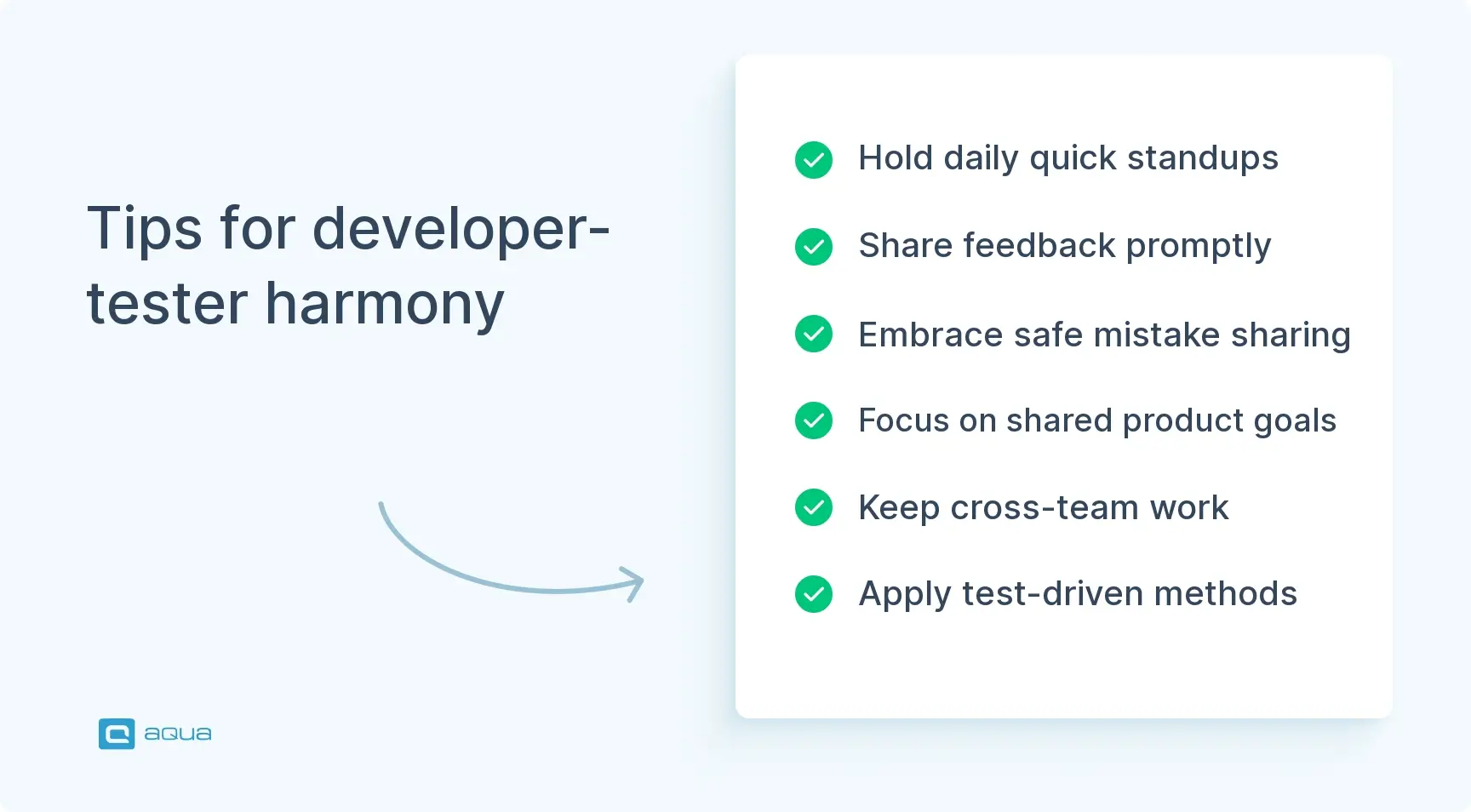
Conclusion
Communication between developers and testers must be clear and effective. That way, you can ensure everyone knows what they’re doing, which will help prevent conflicts down the line. We hope our tips will help your team achieve a new level of success together.
Save up to 6.38 hours/week on QA team communication with aqua